


Regulators have been watching. And now they’re moving.
The previous installments in this series traced how digital wallets evolved from payment front-ends into multi-asset orchestration engines: holding stablecoin pools, tokenized deposits, and CBDC sub-wallets, routing liquidity in real time across rails and ledgers, and concentrating authentication, behavioral telemetry, and transaction initiation in ways that no issuer or processor sitting further back in the stack can match. That argument was about capability. This one is about consequence.
When an interface layer controls identity verification, payment initiation, data access, and digital asset custody at scale, it stops looking like an app. It looks like a financial intermediary. Regulators in the U.S., EU, and across major APAC jurisdictions have reached the same conclusion, and they are responding accordingly. The GENIUS Act, CFPB 1033, MiCA, PSD3, and a widening set of CBDC frameworks are not arriving sequentially. They are arriving simultaneously, converging on a single regulatory thesis: the wallet layer must be supervised with the same rigor as the institutions it mediates.
For most financial institutions, the instinct will be to frame this as a compliance burden: a set of new requirements to be absorbed, budgeted for, and managed around. That framing is wrong, and the institutions that adopt it will pay for it later.
The firms that built model governance, explainability tooling, real-time audit trails, and multi-rail orchestration into their architecture before the mandates landed will find that compliance is largely already done. The firms that did not will face a harder problem: retrofitting governance onto systems that were not designed for it, under regulatory pressure, while competitors who prepared are already moving. Compliance infrastructure, built early, is a competitive asset. Built late, it is an operational constraint.
This final installment examines what the regulatory wave actually requires: not as a checklist, but as a forcing function. It then turns to what institutional readiness looks like in practice: the operating model changes, architectural choices, and governance frameworks that separate institutions positioned to lead wallet-led finance from those that will find themselves executing on terms they did not set.

The regulatory perimeter is moving. For decades, oversight of consumer finance was organized around institutions: banks, card networks, licensed money transmitters. The wallet changed that logic. When a single interface controls authentication, payment initiation, behavioral data collection, and digital asset custody for millions of users, the institution behind it matters less than the interface itself. Regulators have noticed. Across the U.S., EU, and major APAC jurisdictions, the supervisory frame is shifting from entity-based oversight toward interface-level supervision, and the expectations arriving at the wallet layer are bank-grade.
Four regulatory developments define the current wave. They are not arriving sequentially. They are converging.
The GENIUS Act is the clearest U.S. articulation of digital money regulation to date. The framework proposes reserve requirements, licensing standards, audited disclosures, and AML/KYC mandates for stablecoin issuers, effectively pulling stablecoins into the perimeter of regulated financial institutions.1 The Act draws a formal line between fully reserved, fiat-backed stablecoins and other digital assets, requiring transparent reserve composition, regular attestations, and consumer protections tied to broader financial stability objectives. For wallets that custody or route stablecoins, the compliance implications are concrete: token handling standards, identity verification requirements, and real-time monitoring of digital asset flows. With stablecoin market capitalization exceeding $250B and daily settlement volumes above $20B, the relevance is not theoretical.2 The GENIUS Act does not treat stablecoins as a speculative sideshow. It treats them as infrastructure, and the compliance expectations follow from that classification.
J.P. Morgan’s Kinexys platform is worth naming here. The bank spent several years building compliance, identity verification, and auditability into the architecture before the product launched at scale, not as a regulatory add-on, but as the underlying logic of how the system works. Kinexys Digital Payments has processed over $3 trillion in cumulative transaction value, averaging more than $5 billion in daily transactions.
Its programmable payments product enforces predefined rules at execution, with a full auditable history of every event. JPM Coin (JPMD), its USD deposit token, recently extended to public blockchain rails with the same governance layer intact. The compliance infrastructure and the product are the same thing. That is precisely the distinction the GENIUS Act’s framework encodes.
CFPB 1033 opens a second front. Where the GENIUS Act targets digital asset flows, Section 1033 targets data: specifically, the behavioral and transactional datasets that wallets accumulate by virtue of being the user’s primary financial interface. The rule proposes supervisory authority over large nonbank wallet providers, focusing on data access rights, transparency requirements, dispute resolution, and protections for balances that fall outside deposit insurance coverage. The intent is explicit: prevent opaque data use, eliminate dark-pattern interface design, and level the competitive field between banks and nonbank wallet providers by standardizing disclosure, portability, and error resolution. For institutions already operating under bank-grade data governance, 1033 is manageable. For platforms that built their data practices in a lighter regulatory environment, the adjustment is structural.
The rule’s path has been anything but smooth. The 2024 Section 1033 final rule was challenged in court the same day it was issued by Forcht Bank, the Kentucky Bankers Association, and the Bank Policy Institute, who argued it overstepped statutory authority. By mid-2025 the CFPB had initiated a new rulemaking process and the original rule was stayed. A second point of friction has been cost. Smaller institutions have pushed back on the expense of building open API infrastructure, and the CFPB’s August 2025 advance notice drew nearly 14,000 public comments; many of them from community banks and credit unions raising exactly this concern.
The regulatory direction is set. How institutions get there, and at what cost, is still being argued.
MiCA and PSD3 represent Europe’s answer, and taken together they are equally consequential. MiCA establishes harmonized rules for crypto asset issuance, custody, market integrity, and consumer protections across the EU, extending formal authorization requirements and prudential safeguards to wallet providers handling digital assets. PSD3 pushes further into wallet architectures: strong customer authentication standards, standardized open banking APIs, and transparent fee structures become baseline requirements, not competitive differentiators. The EU’s emerging Digital Identity Wallet accelerates the shift toward wallet-native KYC portability, a development that will reshape how identity verification works across borders. The combined effect is an operating environment where cross-border payments require demonstrably compliant infrastructure at every layer of the stack, not just at the institution level.
In practice, MiCA’s rollout has looked less like a single switch being thrown and more like a phased, uneven process across 27 national regulators. Some member states — the Netherlands, Poland, Finland — ran transitional windows that closed as early as mid-2025. Others, including France, Luxembourg, and Malta, are operating under the full 18-month period through July 2026.
ESMA has publicly flagged the problem: different national authorities are giving different answers to the same licensing questions, which creates compliance inconsistency for any wallet provider operating across borders. As of late 2025, roughly 100 CASP licences had been issued across the entire EU. For a regulation that governs an entire asset class across a bloc of 450 million people, that number reflects how early-stage the operational reality still is.
CBDC frameworks introduce the third dimension. Across Europe, China, and a growing set of emerging markets, central banks are designing programmable sovereign money, and in almost every architecture under active consideration, the wallet is the delivery mechanism: responsible for identity binding, consent management, device-level security, and transaction authorization. These frameworks envision wallets managing CBDC sub-accounts, enforcing programmable spending conditions, and interoperating with tokenized bank money. The compliance requirements that follow — device attestation, secure enclaves, real-time monitoring — have to be embedded in wallet infrastructure, not layered on top of it afterward.
What these four developments share is a common destination. Wallet providers are being repositioned as regulated financial intermediaries, not application-layer interfaces that happen to touch money. The expectations increasingly mirror those applied to banks: rigorous identity and fraud controls, transparent disclosures, auditable data governance, capital or reserve requirements for stored value, and continuous oversight of algorithmic decision systems.
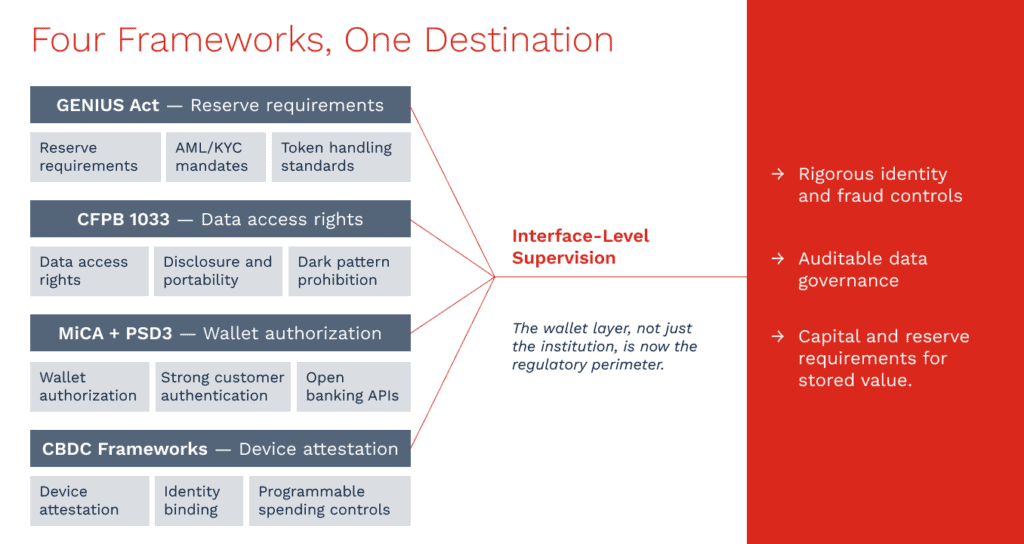
For financial institutions, this creates a fork in the road. Those that have already built model governance, explainability tooling, token eligibility checks, transaction-level attestation, and API-driven data rights frameworks into their wallet architecture will find the regulatory wave largely confirms decisions they already made. Those that have not face a harder problem: the requirements are arriving now, the retrofit is expensive, and the window for building compliance infrastructure as a competitive asset rather than an externally imposed constraint is closing.
The direction is unmistakable. As wallets become personal financial operating systems, regulators are applying supervision at the interface layer with the same intent they have always applied it at the institutional layer. The practical question is no longer whether to comply, but whether the compliance infrastructure was designed from the start or assembled under pressure

The infrastructure argument has been made. Wallets are orchestration engines. Regulators are applying bank-grade supervision at the interface layer. What remains is the harder question: what does an institution actually have to change to compete in this environment?
The honest answer is: most of it.
Incremental upgrades to legacy payment stacks were a viable strategy when wallets were channels. They are not viable when wallets are the point where identity, liquidity, compliance, and execution converge in real time. The institutions that will lead wallet-led finance are not optimizing existing architectures. They are rebuilding around a different center of gravity.
The legacy model organized institutions around discrete products: cards, ACH, RTP, digital assets, each with its own processing logic, risk framework, and compliance stack. That model breaks under PFOS conditions. When a single wallet session might touch instant rails, stablecoin pools, tokenized deposits, and a CBDC sub-account before settling, product-level thinking produces fragmented execution. What is required instead is context-level thinking: a unified orchestration layer that reads identity confidence, device authentication state, liquidity signals, corridor performance, and risk posture simultaneously, then applies consistent policy before any value moves.
The practical implication is organizational as much as technical. Leading institutions are consolidating functions that have historically operated in silos: fraud, risk, identity, payments, treasury, compliance. Not because consolidation is fashionable, but because PFOS-scale execution requires a single decision system governing diverse asset classes, rails, and contexts. Separate teams applying separate frameworks to the same transaction produce inconsistency. Inconsistency, in a real-time multi-asset environment, produces failures and exceptions that are expensive to resolve and difficult to explain to regulators.
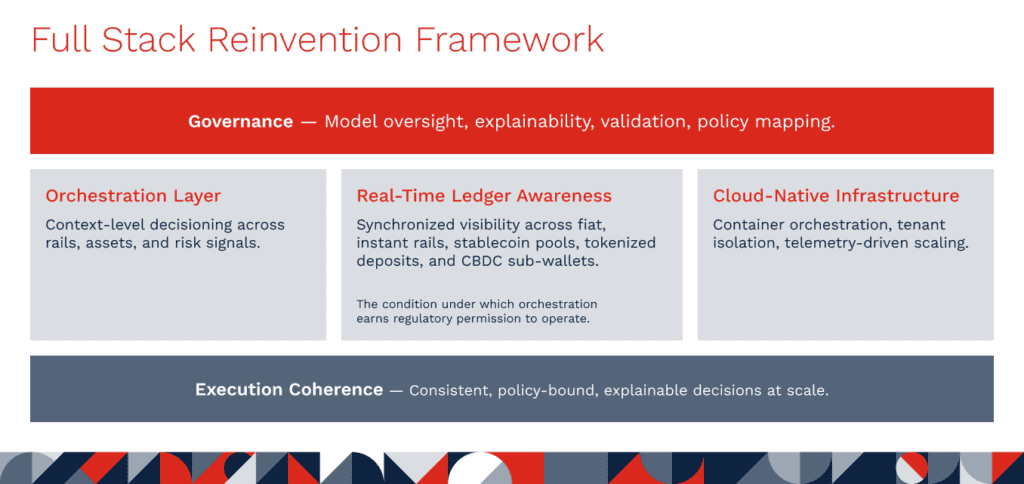
Operating across fiat accounts, instant settlement rails, stablecoin pools, tokenized deposits, and CBDC sub-wallets simultaneously means operating across ledgers with fundamentally different rules: different settlement finality windows, different liquidity consumption profiles, different reversibility constraints, different auditability requirements. Institutions that cannot maintain synchronized visibility across all of them will misallocate liquidity, generate exceptions, and fail to satisfy the real-time monitoring expectations that the GENIUS Act and MiCA are now building in as baseline requirements.
Wise has built a useful point of comparison. Over 14 years, the company has connected directly to eight domestic payment systems — including the UK Faster Payments System, the Eurozone, Singapore, Australia, Brazil’s PIX, and the Philippines’ InstaPay — and holds 80 regulatory licenceslicenses across multiple jurisdictions. These connections were built one at a time, each requiring separate regulatory approval in a different market. The result is that as of early 2026, 75% of
Wise’s transactions settle in under 20 seconds. Traditional banks that are now trying to match this from a standing start are discovering that the gap isn’t just technical.
It’s the product of a decade of accumulated infrastructure decisions they didn’t make.
PFOS-scale wallet ecosystems operate at internet scale: millions of concurrent sessions, multi-party integrations, dynamic throughput across rails and asset classes. The processing architectures built for traditional banking cores were not designed for this. Container orchestration, tenant isolation at the schema level, telemetry-driven scaling, and service mesh configurations are not capabilities institutions can bolt onto existing infrastructure. They require architectural decisions made upstream, before the load arrives. Institutions that have made those decisions will iterate faster, deploy modularly, and absorb new rails and asset classes without rebuilding from scratch each time. Those that have not will find each new capability comes at disproportionate cost and risk.
AI-assisted orchestration can optimize routing, flag anomalies, personalize offers, and manage authentication confidence in real time. What it cannot do is replace policy. Every decision the orchestration layer makes needs to map back to a defined rule or constraint: fraud rules, liquidity limits, sanctions screening, and token eligibility, the decisions that carry legal and regulatory weight. Model governance, drift detection, explainability tooling, and tiered approval logic are not features to be added later. They are the condition under which regulators will permit these systems to operate at the level of autonomy they are capable of. Institutions that treat governance as a foundational design principle from the outset will find it compounds as an advantage. Those that treat it as a compliance layer to be retrofitted will find it becomes the bottleneck.
Whether institutions can actually build this governance layer in time, given the cost of reorganizing legacy architectures while also keeping the lights on, is not a given. The regulatory window is closing. It has not closed yet.
Speed, rail access, and product breadth are table stakes. What separates institutions that lead this market from those that follow is execution coherence: the ability to make consistent, policy-bound, explainable decisions across rails, assets, devices, and jurisdictions in real time, under load, at scale.
Those that achieve it will operate with the coherence the next decade of digital money requires. Those that do not will find themselves increasingly abstracted from the point of interaction, and from the economics that follow it.
Three articles ago, the central provocation was this: the real risk for financial institutions is not disruption. It is irrelevance. The institutions that delay will not lose to better banks. They will lose to platforms that never asked permission to become financial infrastructure in the first place.
That risk is becoming concrete. The timeline is tightening, even if the exact shape of it is not yet settled.
The structure is the wallet. By 2030, digital wallets will account for more than half of global online payment volume, concentrate the behavioral data that makes every other financial product decision possible, and serve as the primary execution surface for stablecoins, tokenized deposits, and sovereign digital currencies. Whoever controls that interface controls the relationship. That was the argument in the first installment of this series. Nothing that has followed has weakened it.
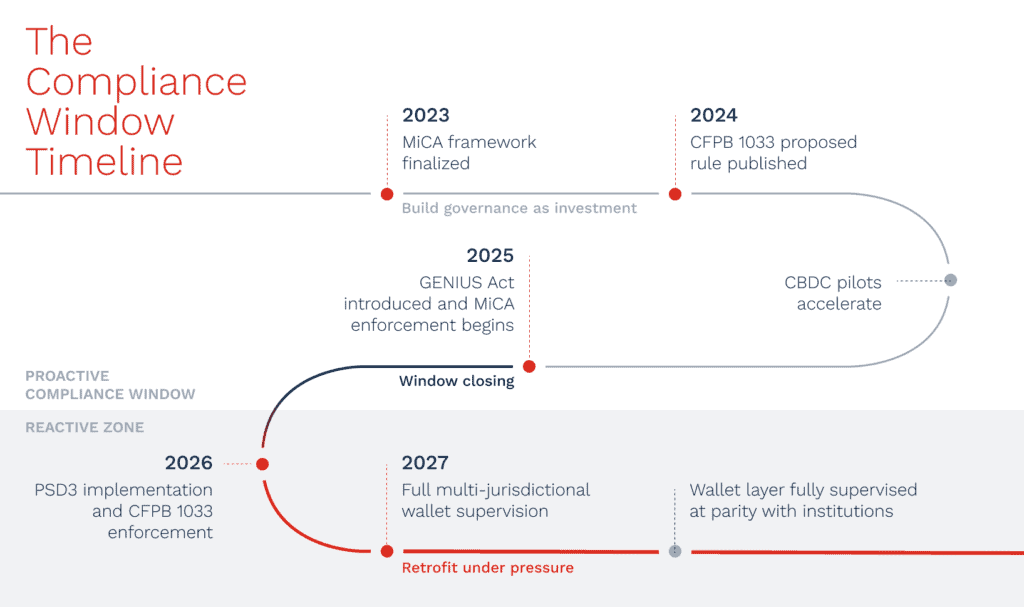
The timeline is now. Regulatory frameworks on both sides of the Atlantic are arriving simultaneously, not sequentially. The GENIUS Act, CFPB 1033, MiCA, and PSD3 do not give institutions years to prepare. They give institutions that already prepared a confirmation, and institutions that did not a problem. The compliance window that existed two years ago, when governance infrastructure could be built as a proactive investment rather than a reactive requirement, is nearly closed.
The mechanism is policy-consistent execution. Not rail access, which is commoditizing. Not product breadth, which any platform can replicate. The institutions that will lead this market are those that can make consistent, policy-bound, explainable decisions across rails, assets, devices, and jurisdictions in real time. That capability does not emerge from a modernization roadmap. It has to be built into the architecture before the load arrives.
The series has traced a single progression: wallets became the center of gravity, then the orchestration layer, then the object of regulatory supervision, and finally the forcing function for a full operating model reinvention.
What remains optional is positioning. Institutions can still choose to build wallet-native orchestration capabilities, embed governance into their execution architecture, and integrate with the digital asset infrastructure that regulators are now formalizing. That window is open. It is not open indefinitely.
The front door of financial services has moved. The institutions that recognize where it is, and build toward it with the urgency the moment actually requires, will define the next decade of digital money. The rest will hold the account while someone else holds the relationship. That was always the risk. Now it has a deadline.
- U.S. Congress. Guiding and Establishing National Innovation for U.S. Stablecoins (GENIUS) Act, 2025. Proposed reserve requirements, licensing standards, AML/KYC mandates, and consumer protections for stablecoin issuers.
- CoinMarketCap; Circle. Stablecoin market size and on-chain settlement trends, including total stablecoin market capitalization surpassing $250B and daily settlement volume benchmarks, 2024–2025.
- Consumer Financial Protection Bureau. Section 1033 Proposed Rule on Personal Financial Data Rights, 2024. Supervisory authority over nonbank wallet providers, data access rights, transparency, and dispute resolution requirements.
- European Commission. Markets in Crypto-Assets (MiCA) Regulation, 2024. Harmonized rules for crypto asset issuance, custody, market integrity, and consumer protections across the EU, including wallet provider authorization requirements.
- Bank for International Settlements. CBDC system design frameworks and wallet-layer delivery architecture, 2024. Central bank digital currency pilots covering privacy rules, programmable settlement, cross-border compatibility, and multi-tier distribution models.
- Worldpay. Global Payments Report 2025. U.S. e-commerce payment mix, digital wallet share, multi-rail operating requirements, and 2030 adoption forecasts.
- Worldpay. Global Payments Report 2024 and 2025; Juniper Research, 2025. Digital wallet global user projections toward approximately 6 billion by 2030, with wallets projected to account for over 50% of global online payment volume.