

In partnership with BIP, a major mining company connected data, management, and field operations through real-time applied intelligence. The initiative brought recommendations directly into the cab and strengthened teams’ decision-making capabilities, delivering consistent gains in efficiency, safety, and productivity at scale.
Monitored assets
Maximum reduction in fuel consumption
Marginal performance improvements in open-pit mining can have a meaningful impact on cost, productivity, and safety. As operators face growing pressure to improve energy efficiency, reduce emissions, and increase operational predictability, turning field data into fast, consistent decisions has become a strategic priority for asset-intensive operations. Applied intelligence solutions are therefore playing an increasingly central role in advancing fleet management and mine haulage.
In partnership with BIP, a major mining company continuously operates an operational intelligence platform that brings data directly to the field. The initiative delivers in-cab speed recommendations to operators and provides an analytics layer for managing mine haulage, contributing to gains in energy efficiency, productivity, and safety.
The platform works across two complementary fronts: an in-cab speed-recommendation system that guides operators segment by segment with clear prompts, and a web application that supports monitoring and decision-making by management teams.
By processing GPS and speed data, suspension and chassis-torsion sensor readings, and equipment-proximity events, the initiative turns complex variables into practical, actionable guidance that optimizes haulage performance in the field.
Today, the solution is deployed across nine operating sites, monitors more than 307 assets, and supports the daily work of more than 2,100 operators in open-pit mining operations.
Energy inefficiency and operational risk in mining
- Fuel-consumption variability: Without a standard operating speed, consumption varied across operators and shifts, with no clear efficiency benchmark for each route segment.
- Reliance on tacit knowledge: Effective driving practices depended on each operator’s individual experience, with no structured mechanism for sharing them across the fleet.
- Gap between analysis and action: Even when efficiency studies were conducted, the findings remained in reports instead of reaching operators while they were driving.
- Lack of integrated visibility: GPS data, chassis-sensor readings, and safety alerts sat in separate systems, without a unified view to enable faster, more effective decisions.
The need for integrated, in-cab intelligence
The data already existed within the operation: GPS, speed history, suspension sensors, and the dispatch system. The challenge was not a lack of information, but the absence of integration and a direct channel for bringing that intelligence into field operations.
The diagnosis identified three priority areas:
- Gap between analysis and the field: Energy-efficiency studies found a negative correlation between suboptimal speed and fuel consumption. However, the resulting intelligence did not reach operators while they were driving.
- Fragmented operational data: Historical speed, route-profile, and chassis-sensor data existed in isolation, without the integration required for a unified operational view.
- Operational inertia: Without a structured mechanism for guiding operators, performance variability across assets, shifts, and work areas remained high and was not systematically addressed.
In-cab recommendations and an integrated analytics layer
The solution was developed to close the gap between analysis and execution by connecting data intelligence directly to field operations. Rather than analyzing performance only after the fact, the system guides operators at the right moment, on the right route segment, and at the optimal speed. At the same time, it gives management teams an analytics tool that can quickly generate insights for use in daily routines and shift handovers.
A key advantage for teams is the autonomy the platform provides to examine mine roads from multiple perspectives, directly and intuitively combining operational-performance, energy-efficiency, and safety indicators. No advance analysis is required: the data is available in real time, when teams need to make decisions.
The speed-recommendation module goes beyond energy efficiency. It helps ensure that management’s operating strategy is executed consistently in the field, reducing communication gaps and dependence on recurring training to standardize driving practices.
The methodology behind the recommendations draws on the operation’s actual history and combines data analysis with operational validation:
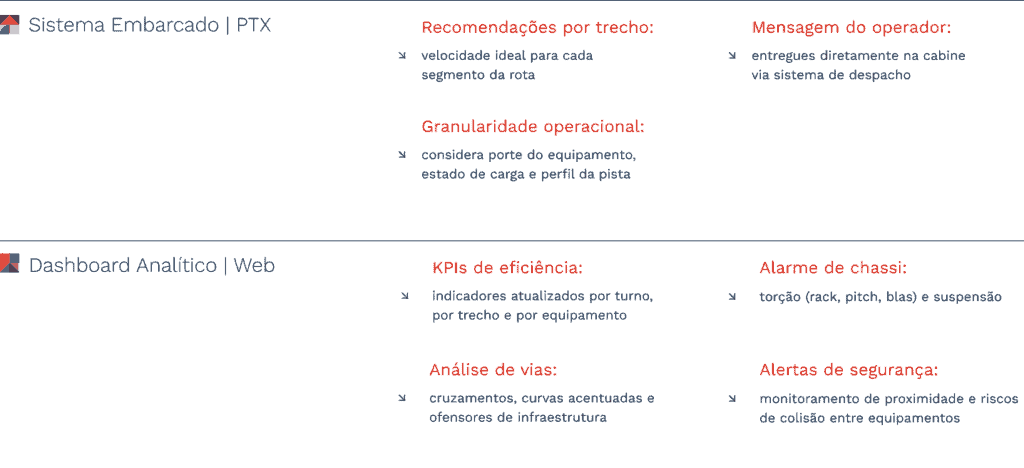
- Recommendations at the right level of detail: Each suggested speed accounts for asset size (200-, 300-, and 400-ton trucks have different dynamics), model and fleet, load status (loaded or empty), and the exact grade of the route segment, whether uphill or downhill. This ensures that recommendations reflect real operating conditions.
- Learning from the operation’s best performance: The recommended speed is not an arbitrary target. It is derived from the fleet’s own historical data by identifying the pattern of the best cycles and turning that behavior into a reference for the entire operation.
- Technical validation before deployment: Engineering teams review the recommendations to ensure compliance with operating rules, infrastructure conditions, and the safety requirements of each site.
- Direct delivery to operators: Speeds are translated into simple, clear prompts displayed in the cab as the truck enters each route segment, using existing infrastructure and enabling immediate application in the field.
- Continuous monitoring and review: Performance is tracked shift by shift, and recommendations are updated periodically to reflect changes in road conditions, fleet composition, and operating context, supporting continuous efficiency improvement.
Technology as an enabler
The solution was designed to integrate with the mine’s existing systems, without requiring new infrastructure or changes to established processes. This makes adoption easier and supports scalable deployment.
- Analytical processing: Python data pipelines extract historical speed patterns and generate recommendations segmented by operating profile, taking contextual variables and fleet behavior into account.
- Web dashboard: An analytics interface tracks efficiency KPIs by shift, supports detailed road analysis—including intersections and sharp curves—monitors chassis alarms, and displays safety alerts for management, infrastructure, and engineering teams.
- Operator messaging: Speed recommendations are delivered directly to the in-cab display through the dispatch system, using infrastructure already installed at the site and creating a direct connection between analysis and execution.
Primary data sources
- Speed history by route segment: Detailed records of actual speeds on each section of the route, used to identify the best operating patterns for each use profile.
- Route profile: The grade of each segment (uphill or downhill), road type, and infrastructure characteristics that provide context for and shape each speed recommendation.
- Equipment profile: Capacity (200, 300, or 400 tons), model, fleet, and load status—variables that define the real-world dynamics of each truck and directly affect operational performance.
- Chassis and suspension sensors: Torsion indicators (rack, pitch, and bias) and related alarms that flag adverse road conditions, operational risks, and potential accelerated asset wear.
- Collision Avoidance System (CAS): Equipment-proximity alerts generated by the onboard detection system, used both for safety monitoring and for analyzing operational hotspots.
Intelligence that drives efficiency, safety, and competitiveness
The solution delivered verified impact across multiple dimensions of the operation, combining gains in energy efficiency, operational safety, and productivity at scale:
Energy Efficiency and Decarbonization
- 3%–8% reduction in fuel consumption: Verified across operations where the solution is active, with the largest site achieving gains of up to 8%. At this scale, that represents hundreds of thousands of liters of diesel saved each month.
- Hundreds of metric tons of CO₂ avoided each month: A direct contribution to decarbonization targets, achieved by optimizing existing operating behavior—without fleet replacement or infrastructure changes.
- Recurring, scalable results: Savings are renewed every shift, across every route segment and every truck supported by the solution, growing in proportion to expansion across additional sites and fleets.
Safety and Risk Mitigation
- Equipment-proximity monitoring: Shift-level alerts support safety teams in proactively managing the fleet and reducing operational risk.
- Asset-integrity diagnostics: Monitoring chassis-torsion and suspension alarms helps identify anomalies that may indicate impending failures or accelerated equipment wear.
- Detailed road analysis: Segmenting intersections and sharp curves helps identify critical infrastructure points that affect both safety and operational efficiency.
Productivity and Operational Management
- Standardization at scale: Performance variability across operators and shifts is systematically reduced, improving haulage-flow predictability and average fleet performance.
- Faster decision-making: The dashboard consolidates efficiency KPIs, road-condition issues, and safety indicators in a single interface, bringing data analysis closer to daily operations.
- Fewer communication gaps: The recommendation module helps ensure that management’s operating strategy is executed directly and consistently in the field, reducing reliance on recurring training to maintain operating standards.
Why did BIP’s approach work?
The solution’s success is directly tied to how it was designed: starting from real operational challenges and connecting data, technology, and execution in an integrated way.
Several factors were critical:
- Direct connection between analysis and execution
The intelligence was not confined to dashboards or reports. It was embedded at the point of decision—inside the operator’s cab—so it could be applied in the field. - Use of the operation’s own data
Recommendations are based on the fleet’s historical data, reflecting proven practices already present in the operation and aligning with real operating conditions. - Integration of multiple data sources
Combining GPS, sensor, route-profile, and safety data created a comprehensive view of operations and improved the quality of recommendations. - Balance between technology and usability
The solution was designed to be simple for operators and powerful for management, enabling adoption at scale. - Continuous, data-driven improvement
The model learns from operations and is continually updated to reflect changes in context, fleet, and infrastructure.
What can industry leaders learn from this case study?
Mining and logistics operations share similar challenges involving scale, variability, and dependence on critical decisions in the field.
This case study offers several relevant lessons:
- Value comes not only from data, but from applying it
Many operations already have the data they need but still struggle to turn it into concrete action in day-to-day work. - Standardization at scale requires technology in the field
Training and guidelines alone are not enough to ensure operational consistency; execution must be supported by embedded intelligence. - Real-time decision-making is a competitive advantage
Reducing the time between analysis and action has a direct impact on efficiency, cost, and safety. - Data integration creates a system-wide view
Connecting different information sources reveals patterns and opportunities that would remain hidden in isolation. - Operational transformation can begin with existing assets
Significant gains can be achieved without major capital investment by making better use of data that is already available.
From data analysis to operational transformation
The solution demonstrates that transforming mine operations does not necessarily require new equipment or major infrastructure investment. It depends on the ability to extract value from existing data and connect it to real-time decision-making.
By turning operational data into practical in-cab recommendations and actionable management insights, the solution redefines how the operation is run—reducing variability, increasing efficiency, and strengthening control over fleet performance.
More than an analytics tool, smart mining establishes a new operating model in which decision-making, execution, and continuous learning become part of the same integrated flow. The model adapts to operating conditions, evolves over time, and scales consistently.
As energy efficiency, safety, and productivity become increasingly critical, the ability to turn data into action is no longer a differentiator—it is a competitive imperative. Capturing that value consistently requires democratizing artificial intelligence across the operation. How much further could your operation advance using the data it already has?
experts:
Our team brings together strategy, technology, and execution to design high-impact programs for complex mining and asset-intensive environments. If operational efficiency and asset management are on your strategic agenda, talk to our experts to learn how we can help.