

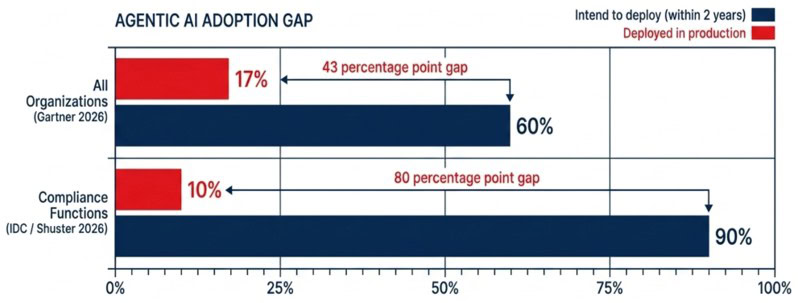
Ask a room of capital markets executives whether agentic AI matters and nearly every hand goes up. Ask how many have it running in production and the room thins out fast. Gartner’s 2026 read captures the split: about 17% of organizations have deployed AI agents, while more than 60% expect to within two years, the steepest adoption curve of any emerging technology the firm tracks.1 The distance between intent and installation is the most honest description of where the market sits.
For executives, this gap is becoming a strategic differentiator. Firms that identify where agentic AI delivers measurable operational improvements today will be better positioned to scale higher-value use cases as AI governance, data quality, and organizational confidence mature.
The Agentic AI Adoption GAP in Capital Markets:
The more relevant question is where agentic AI is already creating competitive advantage across capital markets. For now, the answer is far less visible than many expected. The value has landed in the back and middle office operations, well away from the trading desk.
Consider what is genuinely in production. Broadridge processes a large share of the industry’s post-trade volume, and in May 2026 it moved its agentic capabilities into live operation across capital markets and wealth workflows. The agents handle trade-fail management and break resolution, account opening and maintenance, valuation exception handling, customer inquiry processing. Broadridge reports that new clients can reach up to 30% operational cost reduction on the first day, and that the capabilities were hardened across more than 40 managed-services clients since 2024.2 This is exception handling at industrial scale.
The pattern repeats across functions. In compliance, where roughly one in ten financial institutions used AI in the prior year, close to 90% plan to within the next twelve months.4 In onboarding and due diligence, agents watch for regulatory change and refresh client risk profiles continuously, replacing the brittle periodic cycle most firms still run on. In research, they gather and summarize, shifting human effort from collecting information to judging what it means. These are repetitive, high-volume tasks that people found tedious and firms found expensive.
The economics explain the appetite. IDC puts the return on agentic AI investment at roughly 2.3 times, with payback inside about thirteen months, and ranks building custom agents as the single largest area of increased technology spending among capital markets firms in 2026.4 Numbers like that do not ask for a leap of faith. They ask for an implementation plan.
So why has the value settled in operations? The honest reason is risk tolerance, not capability. An agent that clears a settlement break works inside a deterministic system: right answers, an audit trail, a human reviewing the hard cases. When it errs, the error is visible, contained, and you can unwind it. The IMF has framed the underlying tension cleanly. Agentic systems are adaptive and probabilistic; financial market infrastructure is deterministic and unforgiving; reconciling those two logics is an engineering problem, and a genuinely hard one.3 Operations is where that reconciliation is easiest, because a mistake stays small and the workflow is well defined.
Where Agents Earn Their Keep: Mapping Risk Tolerance to Agent Suitability
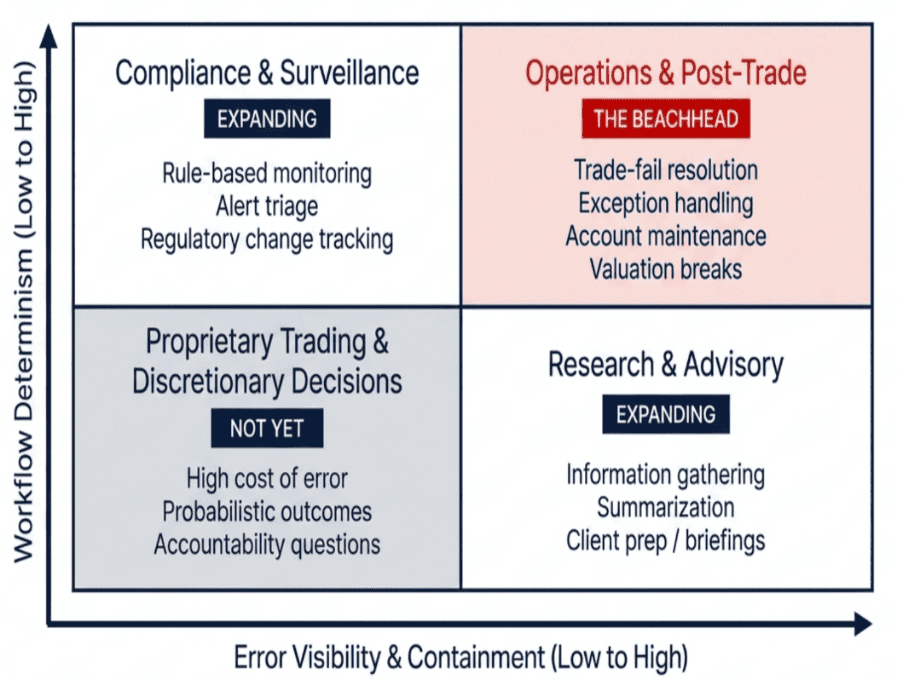
The trading seat is the mirror image. The same probabilistic behavior that makes an agent useful on the desk also makes it hazardous, and the cost of a wrong call is neither small nor easily undone. That is the subject of the next article. The industry has, sensibly, started where the downside is contained.
Comparative Operational and Risk Dimensions
Dimension | Operations (Middle/Back Office) | Trading Desk (Front Office) |
Workflow Logic | Deterministic | Probabilistic |
Error Visibility | High Visibility (locally contained) | Low Visibility (embedded systemically) |
Cost of Failure | Low/ Mathematically reversible | High / Irreversible market impact |
Accountability Structure | Standard audit trails, clear exception handling paths | Undefined human-agent liability split |
Regulatory Clarity | High (workflow fits existing operational risk frameworks) | Vacuum (Excluded from SR 11-7 Model-risk guidance) |
This is where I push a client harder than the vendor decks tend to. The firms pulling ahead are not the ones with the slickest autonomous-trading demo. They are the ones treating agentic AI as an operating-model decision instead of a feature to bolt on, and the difference shows up in who actually ships. Gartner notes something unusual on the maturity curve: AI governance, security, and cost discipline are appearing early, ahead of large-scale deployment.1 Firms that lay those foundations first are the ones turning pilots into production.
Most do not manage it. The surveys keep finding the same wall. Far more firms intend to deploy than succeed, and what stops them is data readiness and AI governance. Model quality is rarely the binding constraint.4 So the hype is not wrong about agentic AI. It is aimed at the wrong target. The win on the table today is operational leverage, and plenty of firms are leaving it there while they hold out for a more glamorous use case.
There is a strategic case for taking the dull work seriously that goes past the immediate payback. Every break an agent resolves and every alert it triages builds the data discipline, the control framework, and the institutional trust that any higher-stakes use will eventually demand.
A firm that industrializes agentic operations is cutting cost today and buying itself the standing to move further when the moment arrives.
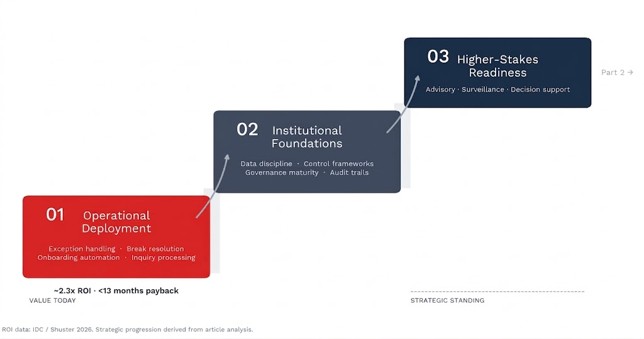
Operations have become the proving ground. The next challenge lies where the cost of being wrong is no longer operational, but financial. In Part 2, we examine why the trading desk remains the toughest frontier for agentic AI adoption, and what will determine when, or if, that changes.
- Gartner, Hype Cycle for Agentic AI, 2026. Adoption rates; governance, security, and cost-control profiles.
- Broadridge Financial Solutions, Broadridge Deploys Agentic AI at Institutional Scale, 2026. Production post-trade and wealth workflows; client scale and cost reduction.
- International Monetary Fund, How Agentic AI Will Reshape Payments, 2026. Probabilistic agents versus deterministic infrastructure.
- Shuster, T., How Frontier Firms Use Agentic AI to Gain an Edge in Capital Markets, 2026. IDC analysis via The Microsoft Cloud Blog; ROI, payback period, and compliance adoption.
- Gartner, Hype Cycle for Agentic AI, 2026; Shuster, T., How Frontier Firms Use Agentic AI to Gain an Edge in Capital Markets, 2026.